Mohammedia · Neighbourhood analysis
Quartier du Parc (Mohammedia): Maârif prices, without the yield
In July 2026 listings, a flat in the Quartier du Parc sells for 14 979 MAD per m², against 15 328 MAD in the Maârif, with a rental yield a fifth lower.
Mohammedia is often pitched as the sensible alternative to Casablanca: thirty kilometres less traffic, the sea at the end of the street. Prices, in theory, should follow. In the most sought-after district in town, that last promise does not hold. The Quartier du Parc sits at Casablanca's Maârif price levels, while the asking rent stays at commuter-town levels.
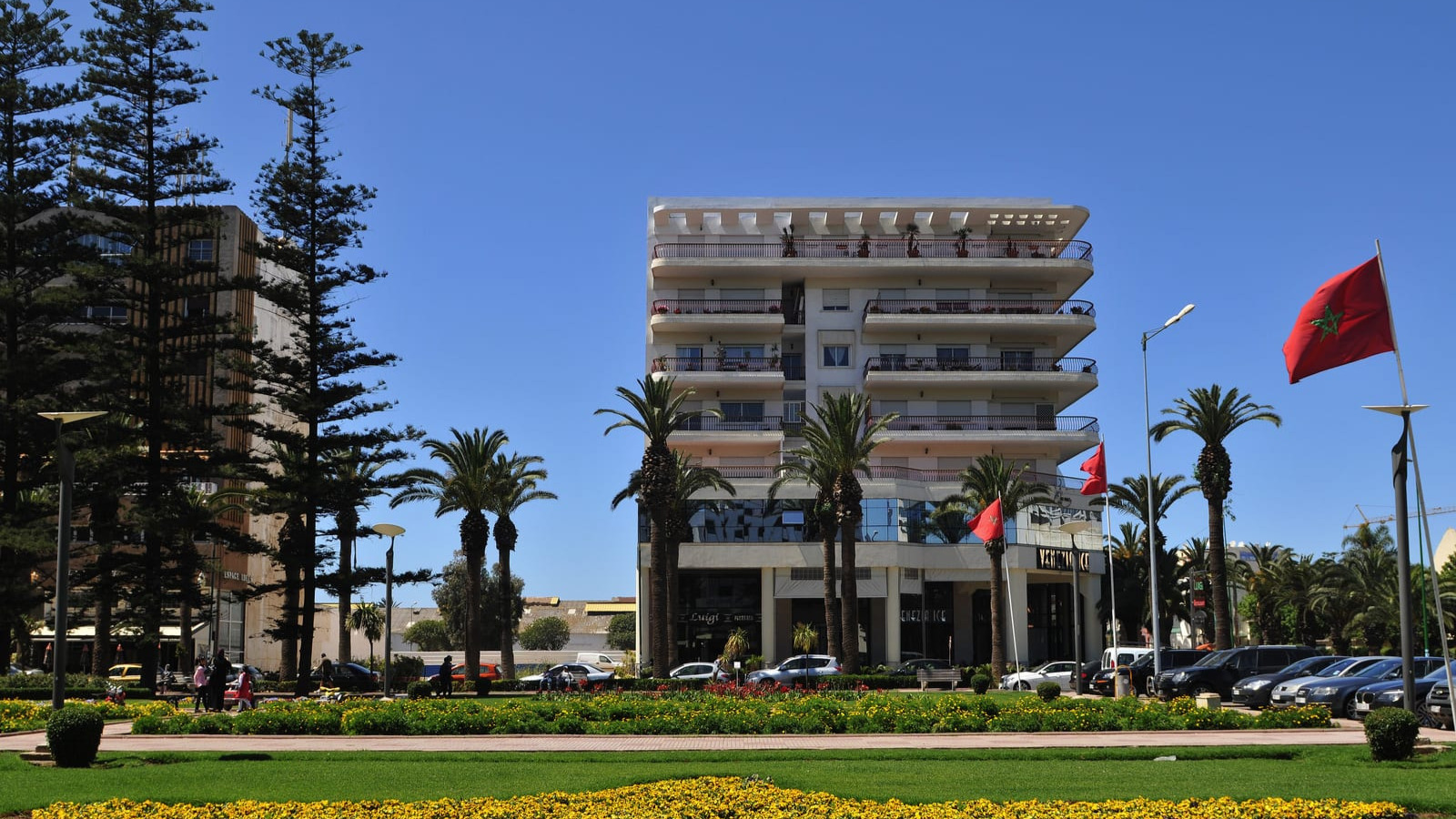
Let us place it first, because the name means nothing to anyone who does not know the city. The Quartier du Parc occupies the centre of Mohammedia and is laid out around the public garden it takes its name from. It stretches between the main shopping street and Miramar beach, which is within walking distance. The railway station, on the Casablanca-Rabat line, is around two kilometres away; Casablanca is about thirty, and Mohammed V airport about fifty. The building stock consists of four- to seven-storey blocks, nearly always with a lift and underground parking. A significant share of the developments dates from the last five years. This is the district buyers default to when they want a central address without being on the seafront.
The figure
The median asking price stands at 14 979 MAD/m², with a median budget of 1 467 500 MAD and a median floor area of 104 m². Forty-four flat listings went on sale during the month, well above the threshold at which we publish a median.
A word on what "median" means. The median is the value that splits the listings into two halves: as many properties advertised below 14 979 MAD/m² as above. We never publish an average, because a single villa at 8 million within a sample of forty listings is enough to push it up by several thousand dirhams, whereas the median barely moves.
On the rental side, sixty-two listings give a median asking rent of 80 MAD/m², or 7 000 MAD per month for 85 m².
The ratio between the two gives a gross rental yield of 6.4%: a property bought at 1 467 500 MAD and let at the district's median rent generates around 94 000 MAD in rent over a full year, before a single cost is deducted. It is an order of magnitude for comparing districts with one another, not a forecast of what a landlord will actually collect.
What it costs elsewhere
| District | Asking price (MAD/m²) | Median budget (MAD) | Asking rent (MAD/m²) | Gross yield |
|---|---|---|---|---|
| Guéliz (Marrakesh) | 21 366 | 1 500 000 | 115 | 6.5% |
| Agdal (Rabat) | 20 000 | 3 150 000 | 107 | 6.4% |
| Centre Ville (Tangier) | 16 036 | 1 975 000 | 85 | 6.4% |
| Maârif (Casablanca) | 15 328 | 1 950 000 | 103 | 8.1% |
| Quartier du Parc (Mohammedia) | 14 979 | 1 467 500 | 80 | 6.4% |
Four of these five districts sit within a yield band of 6.4% to 6.5%. The Quartier du Parc falls into it without surprise. The outlier in the table is the Maârif, where the asking rent per m² exceeds Mohammedia's by close to 30% for a virtually identical sale price.
Put differently: at an equal budget per m², a buyer chasing rental yield has little to argue for in Mohammedia, since Casablanca's Maârif square metre returns more.
A market without spread
Line up the forty-four listings from cheapest to dearest, then cut the queue into four equal groups. The boundary separating the first group from the second is the first quartile; the one separating the third from the fourth is the third quartile. Between them sits the central half of the listings: a quarter of the stock is cheaper, a quarter is dearer.
Here, that central half runs from 14 284 to 15 653 MAD/m², a ratio of 1.10 between the two bounds.
It is the tightest spread we observe across the Moroccan districts we track. For comparison, Tangier shows ratios of 1.2 to 1.6 depending on the district, and the price gap between its cheapest and dearest districts runs from one to three.
Two readings are possible. Either the district's housing stock is genuinely homogeneous: same construction era, same standards, same kind of location. Or sellers are anchoring on one another, and the advertised price owes as much to local convention as to the value of the property.
For a buyer, the practical consequence is the same either way: finding a listing clearly below 14 284 MAD/m² should trigger a check, not a reflex to buy. At this level of price uniformity, a 15% discount usually has a specific cause: a floor without a lift, the orientation, or the legal status of the title.
Stock does not turn over quickly
The median time observed between a listing going online and disappearing is 130 days. The median age of listings still online is 105 days, and 25% of the month's listings are no longer visible by the end of the period.
The first two figures do not count the same properties. The time measure covers listings already gone: how long they held before disappearing. Stock age covers those still there at the moment of measurement: how long they have been waiting. A district that sells quickly shows both figures at low levels, whereas here both exceed the quarter.
That last figure measures turnover, not sales: a listing disappears whether it sold, the seller withdrew it, or it simply expired. But a median shelf life of four months, in a district where prices are aligned almost to the dirham, points to a market where the seller waits for their price rather than adjusting it.
That is useful information in a negotiation. A property advertised for more than four months at 15 000 MAD/m² has already shown that this price does not find a buyer straight away.
The typical property
Supply is dominated by three-room flats: 20 of the 44 listings, against 13 four-room ones. Smaller configurations are marginal: six one- or two-room listings in total. An investor after a small, easily let unit will not find much here; the district is built for family housing.
In the rental market the mix is broader: 27 of the 62 listings are one- or two-room flats, at a median rent of 7 000 MAD. Rental demand therefore exists for formats the sale market barely offers.
For a Moroccan buyer living abroad
The Quartier du Parc holds up if the aim is personal use: a second home, a return to the country, proximity to Casablanca without living there. The median entry ticket, 1 467 500 MAD, remains close to 25% below the Maârif's. The gap comes from the size of the properties, not the unit price: 104 m² of median floor area against 134 m².
It holds up less well as a rental investment. The stated 6.4% yield is gross: once service charges, the residence tax and vacancy periods are deducted, it drops noticeably. No discount on the price per m² comes to offset that.
Three benchmarks before making an offer:
- Compare the asking price against the 14 284 to 15 653 MAD/m² band. Above it, there needs to be an objective reason.
- Ask how long the property has been on the market. Beyond four months, the room for negotiation is real.
- Have the land title checked by a notary before paying any deposit, particularly on properties originating from cooperatives; we cover this point in our article on the widadiya.
The figures on this page refer to asking prices in listings, not to actual transaction prices, which are not public in Morocco. They are updated monthly. You can follow the district's trajectory on the Mohammedia map.